

Part I: Why Patreon and Substack Exist
These platforms solve different problems—but do they still?

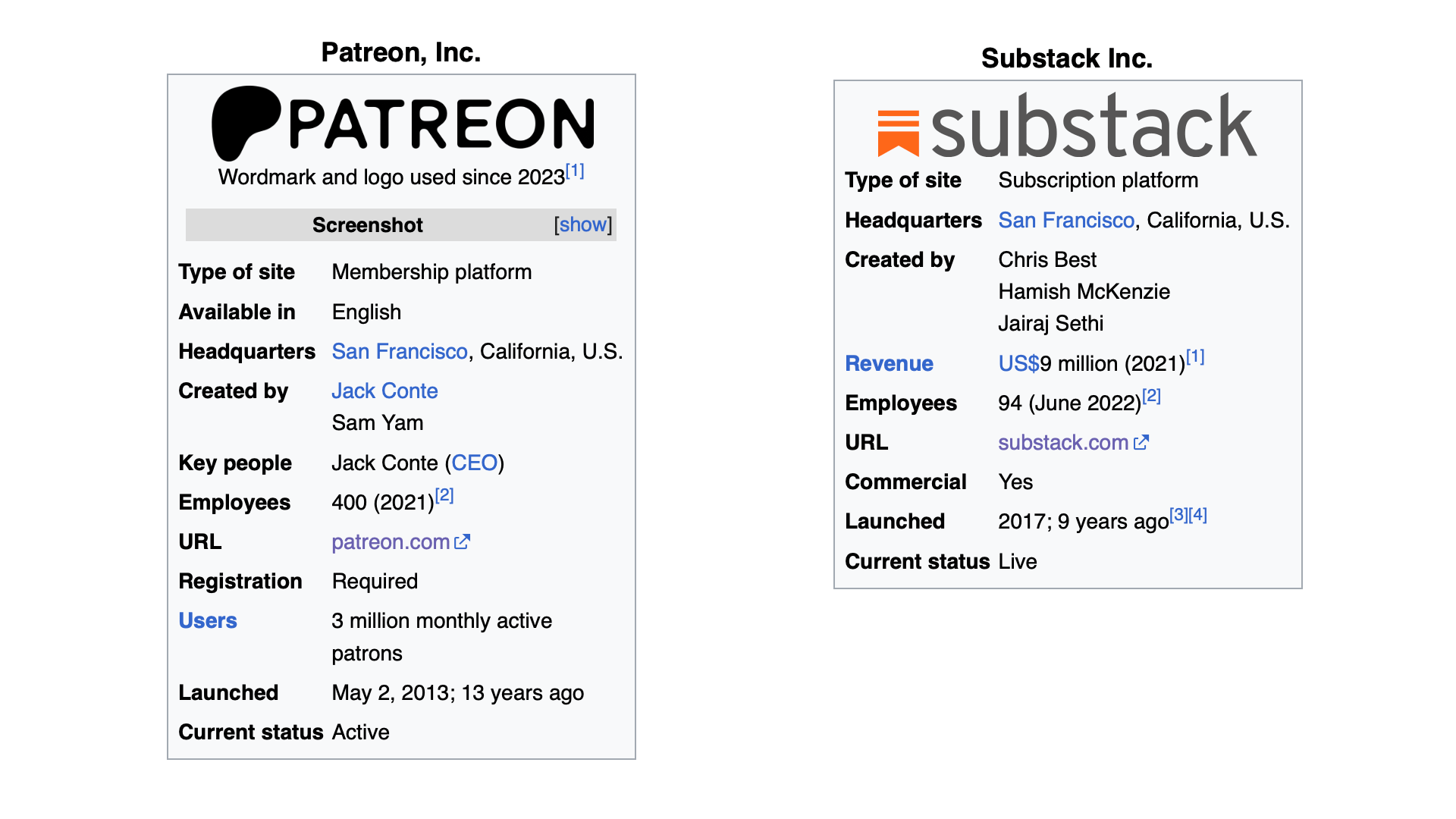
There are many comparisons that can be made between Patreon and Substack but I thought a good place to at least start is in dissecting them both. Here are some facts I was able to find online either from their own About pages, Wikipedia, and other news sources:
THE PATREON FACTS
Patreon launched in 2013.
300k+ Creators on the platform.
Patreon was designed to let creators receive ongoing support.
At Patreon, we spend every day building toward a future where creators are in control and real community thrives. It’s a future where creators can make what excites them most without having to worry about feeding an unpredictable, ever-changing algorithm. And it’s a future where fans and creators have a direct line of access to one another, with nothing standing in between.
Slogan: Creativity, powered by you. / Make art, not content.
THE SUBSTACK FACTS
Substack launched in 2017.
17k+ Users (writers & creators) on the platform
Substack was designed to help writers own their audience.
Build a paid subscriber base. Own every word and every direct relationship. Whether you’re running a solo business or a full newsroom, Substack is built for you.
Media companies / Writers and journalists / Podcasters and video creators / Experts, educators, creative voices
Slogan: Substack is the home for great culture
Before Patreon and Substack…
Long before there Patreon and Substack came on the scene there were plenty of other ways to “be seen” on the internet. Some of those ways are still used today and in fact, are probably more widely used than we care to admit. We fiction writers exist in a silo unto ourselves and so the wider world might seem to be the same as the one we’ve grown into but in fact it isn’t. All of this to say, here are some familiar places you may have once existed in, still do, and visit from time to time as the need arises:
Blogs - I’m thinking Live Journal, Tumblr, Wordpress, Blogspot, etc. If you recognize these names then you are my people. If you don’t, then you missed out on the coming of age for blogging way back in the 90s and early 2000s.
Twitter - Yes, before there was X there was a place where you connected with total strangers at 140 characters at a time! Again, IYKYK on that front. But then social media expanded into this endless sea of voices and ads and hatred. And what once was just a cool place to be for “people my age” back in my early 20s, suddenly became a place where everyone from the under age to the over 50 went to tell you how they really felt and it got too real and awful much too quickly.
Facebook (Pages) - I’m old enough to remember when the only way you could even get a Facebook account was to have a .edu email address from your college. Back when it was cool and free from ad and :gasp: parents, aka older people! Then, I remember when my mom got a Facebook account and having to explain to her what the Facebook Wall was and having her call me in a panic saying she can’t see the wall anymore and I thought she had gone blind but in fact she was referring to Facebook on her computer and I spent way too much time trying to figure out how to fix her issue over the phone. Ugh! It’s no wonder I don’t even have the Facebook app on any of my devices anymore! But in the good ole days I did run a few Pages and it was a great time. I met some really amazing people. Some of whom I am still friends with to this day.
RSS feeds - This was much less a community thing and more of a way to connect with the rest of the world or certain hobbies. I’m sure I don’t have to explain to you what an RSS feed is or the advent of RSS readers that made collecting everything that much easier but then all quickly monetized themselves and now I have to pay for the convenience of gathering the latest news from my favorite sites. Instapaper and Feedly were my go-to RSS readers back in the day.
Email newsletters - Lastly, we enter the world of Mailchimp and over similar providers that gave us the opportunity to have a mailing list but only so long as we adhered to their very strict and pre-defined rules. And if we should dare stray from them, then we’d have to pay handsomely. I felt quickly disincentivized to grow my email list because I knew once I hit a certain number I would have to start paying from money I didn’t have. And the idea of sending an email daily like I did back when I was writing my 100 word stories a day? That was a HUGE no-no! Unfortunately, they were the only game in town. Now they aren’t so I’m almost curious to know if they’ve changed their business strategy or if not enough people who use their services know the grass is greener on the other side or it’s just possible Mailchimp was never for me and therefore it was the right decision for me to leave but is in the best interest of others to stay right where they are.
Fast forward to 2013 and the creator economy that previously had to contend with earning a living from Youtube or Mailchimp (and some other more or less lucrative platforms) now had a new game in town…
PATREON TODAY
Memberships - This is definitely not a new concept. Creating memberships and tiers has been a possibility since Wordpress allowed Plugins on their .org site. But places like Youtube didn’t have it yet (though they would get their own “Join” feature later on and likely to compete with the memberships happening elsewhere). But the idea of a place that seemed to be combining things that we used to have to paste together from different aspects of the internet appealed. But it came with a HUGE caveat that I’ll get to in a bit.
Rewards - Providing a rewards, physical or digital, seemed to come as second nature for creators. Heck, we were creating the rewards already. Now we had a much more streamlined and easier way to monetize it. And in the early days it was the only way to go. It’s just recently that Patreon has introduced this idea of creating free content for visitors to then convert to paid over time. Believe it or not, in the early days Patreon felt to me very much like a Paid Membership first platform. And the way they worked around that model was to offer Per Creation or Monthly options for us to use. If you felt that whatever you were producing wouldn’t be on a monthly basis then you could decide to only charge the subscription at whatever tier when that thing was ready. And very often those of us who chose that option would stipulate that we would never create two things a month or charge a subscriber more than just the one time a month. So, in theory it was like having a monthly subscriber except you didn’t have to feel badly if there were months where you had nothing to share. I’m not 100% sure this option still exists today as they now have a pay-per-post option which sort of takes the place of Per Creation.
Communities - This might not mean what you think. In the early days Patreon had communities, just not inside Patreon. I can remember being a member of Discord servers where they would have a Patreon channel just to discuss how it was going. Share advice with each other. Even on Facebook there would be groups just for this sort of thing. A way to find other users of Patreon and understand where they were going to get people to our respective Patreon pages and eventually to become paid subscribers. It was hard to figure out in the early days.
Dependence on outside discovery - The main issue that so many of us had to contend with in the early days was lack of discoverability. The only way someone knew if you had a Patreon was simply to list it in your bio on whatever social media account you had or add it as a clickable icon in your newsletter or on your website somewhere. That meant you had to do the heavy lifting to finding the readers to bring to your work. Back then it was mostly Reddit or Twitter and the former was a cesspool of rules that everyone had to follow, chief among them was to never self-promote, even in places where that was the point of the existence of the Subreddit to begin with! It was and still is insanity built on insanity. Then you had Twitter which forced you inter a tweeter of few words to try and convey, LOOK AT ME LOOK AT ME. This was before scrolling became an Olympic sport and what you saw on your timeline was actually the tweets of whoever you were following! What a novel concept to think about today where that is just impossible. I swear every time I open X I can never find even one post written by a person I know I am intentionally following. I’m scrolling forEVER before I finally get past all the ads and suggested accounts I should be following to see someone I recognize. And yes, I can change my view and fix who I’m following but when the owners of a platform can literally do whatever they want and force you to see and behave exactly how they dictate… In short, I’m glad Patreon is finally pivoting away from depending on outside forces to drive traffic and realizing they need to build it themselves off the backs of the millions of us who’ve been bringing our subscribers to their site for over a decade now.
SUBSTACK TODAY
Newsletters - This seems quite silly of me to say now, but before Substack the idea of putting fiction in a newsletter that was going to be emailed to my subscribers seemed foreign to me. I never even considered it. Yes, I used Patreon, but to me that was different. This was a time when anyone who was on Patreon was automatically a paid subscriber. The only way they could access my content was to pay for entry. It’s only recently that they’ve changed that model and I’m not only allowed but encouraged to write posts that are free for anyone. So, a lot of credit has to be given to Substack for opening my eyes to the possibility of not only including my fiction in emails but to send emails every single day with fiction for 1,000 consecutive days! I can’t honestly say I would’ve ever thought to do that anywhere else.
Recommendations - It seems such a simple thing in theory but again, before Substack, the only way I knew to get recommendations was through a service like BookFunnel that had group promotions or newsletter swaps. But those are always just one off instances that lasted for either one email or a set period of time. Then Substack came along and provided a way for us to recommend each other indefinitely. We say who we recommend and give a reason why, set it, and Substack does the rest. It never stops or ends until you decide to stop it. Last time I checked there was no limit to how many Substacks can be recommended. And I can confidently say that at least 50% of my subscribers have come exclusively from others Recommending me.
Notes - Many who join Substack today will tell you the reason they keep coming back is just as powerful as the reason they leave and that’s the introduction of Notes to the platform. Many love it. I loved it. I saw the potential right away. A much better place to be and spend time than any other social media platform. Where no ads are ever seen and we all just “get along.” But eventually the good times faded away. As the platform grows and more and more people flood Notes with their own opinions and ever-growing niche topics of interest it can become harder to avoid the noise. More people will always make more noise. Which means we then have to work twice as hard to block and to mute and to ensure we’re following the voices we want to hear. I can see how it can all become overwhelming over time. I feel overwhelmed now with it and find myself using it less and less.
Internal discovery - This is why it’s hard to leave Substack. Even before Notes came on the scene Substack managed to figure out a way to help me grow my audience without my having to lift a finger! Gone were the days of using BookFunnel and trying to get subscribers who I knew were less likely to stick around and actually care about what I’m doing with my fiction. BookFunnel is designed to give away free things in return for an email address. Substack is designed to let potential subscribers check you out first before they decide to give up their email. It’s not a freebie service. And that makes all the difference and keeps us coming back for the hope that the growth will continue and hopefully, some day, turn those subscribers into paid customers.
Community Question
Have either Patreon or Substack strayed from their initial purpose and goals? How? Why?